



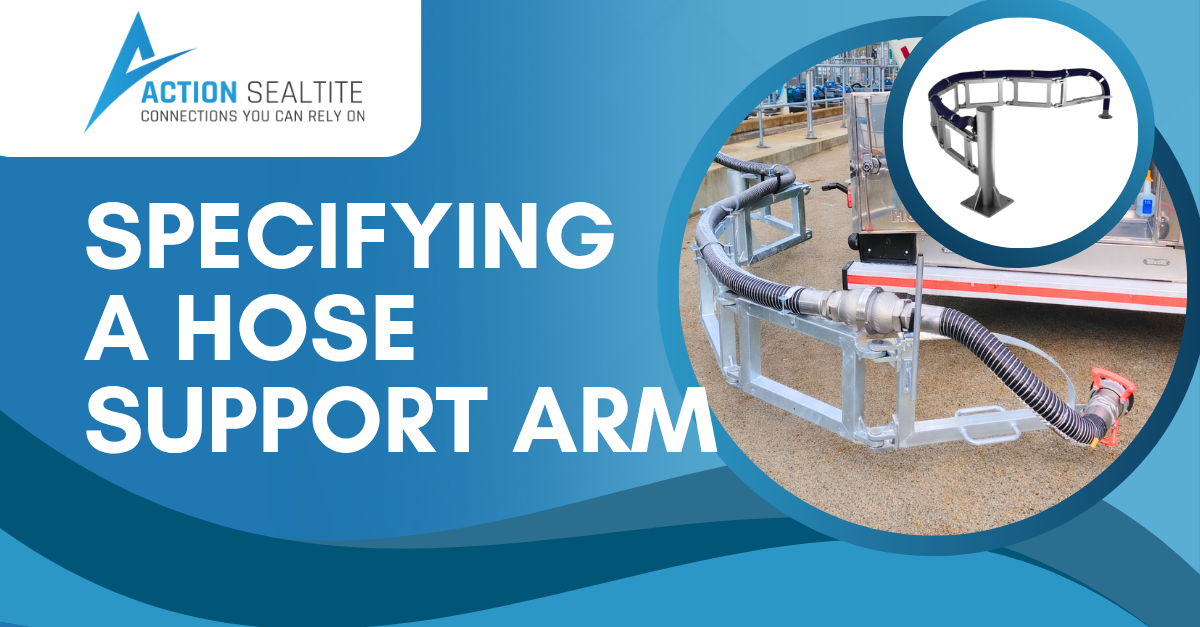
Choosing the right hose support arm is essential for ensuring safe, efficient, and long‑lasting loading or offloading operations. While it may seem like a straightforward piece of equipment, the correct specification depends on several important factors. Here’s a quick guide to what you should consider before placing an order.
1. New vs. Existing Applications
Start by identifying whether you’re working with a brand‑new installation or upgrading an existing setup.
For existing applications, knowing your current hose length helps ensure the new support arm fits seamlessly into your operation.
2. Measuring the Required Arm Length
Accurate measurement is key. You’ll need the distance from your pipework to the centre of the standpost.
Hose support arms come in various lengths (typically from 2500mm to 5500mm) so selecting the correct option ensures proper reach, minimal strain on the hose, and safe operator use.
If you’re using a 700mm standpost, remember: your maximum hose length from the end section (including overhang) should not exceed 1100mm.
3. Choosing the Correct Hose Size
Your hose’s nominal bore (e.g., 1”, 1.5”, 2”, 3”, 4”) directly influences the arm design and load capacity.
Larger hoses and those carrying heavier media require more robust support.
4. Selecting the Right Arm Material
The operating environment and product being transferred will guide your choice of materials:
- Galvanised steel – Durable, cost‑effective, and suitable for many general applications.
- 304 stainless steel – Ideal for corrosive environments or hygienic/chemical duties.
Your product, location, and regulatory requirements will usually dictate which is best.
5. Standpost and Mounting Options
Your mounting setup affects stability and reach. Options include:
- 700mm standpost – Designed for top-supported hoses.
- Standposts up to 2.5m – Suitable for universal mounting or applications needing more height.
- Wall/standpost mounting brackets – For installations where a traditional post isn’t practical.
Choosing the right mounting method ensures safe hose movement and access.
6. Understanding Your Tanker Requirements
To specify the support arm correctly, consider:
- The type of tanker you’re loading or offloading.
- The position and height of the connection point.
- Whether the hose needs to support movement during filling or emptying.
These details ensure your hose arm aligns perfectly with tanker couplings during operation.
7. Weight of the Hose When Wet
If the hose remains full between operations, its weight increases significantly.
Providing the combined weight of the hose and its contents allows the supplier to size the counterbalance or arm strength appropriately.
8. Single vs. Multiple Hose Support
Some operations require the support arm to carry more than one hose simultaneously.
If that’s the case, both the arm and mounting system must be designed for the added load and spacing.
9. Product, Hose Type & Coupling Details
To finish your specification:
- Identify the product flowing through the hose.
- Share the hose brand/model or data sheet if possible.
- Confirm whether dry-break or breakaway couplings are used, including size and material.
These details ensure full compatibility and prevent torsion, stress, or premature wear.
Do You Need a Complete Package?
Action Sealtite can also quote for hoses, couplings, or dry-break systems as part of a complete assembly.
This ensures all components are correctly matched for performance and safety.
Contact Us Form
Call: +44 (0)1235 512500
Email: sales@actionsealtite.com