



What Are Dry Break Fittings?
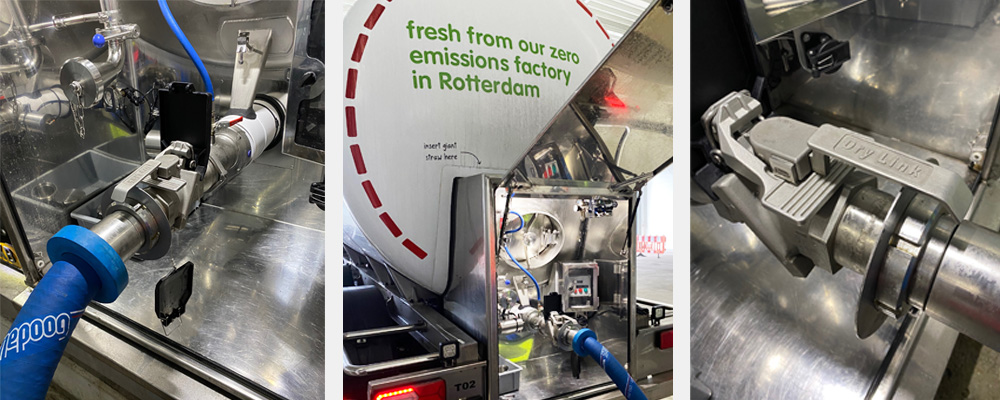
Dry break or dry disconnect fittings utilise a unique mechanism that automatically seals both ends of a line when the hose is disconnected. This makes them particularly useful in applications where spillage is not an option. This could be due to health and safety concerns, if consideration has to be given to the cost of fluid being wasted, or simply to prevent issues with cleanliness. To find out more about how our dry break couplings can help your unique requirements, contact a member of our team today.
Typical Applications
Due to their extreme capability for preventing spillages and fluid waste, our range of dry break couplings have many applications across multiple industries. Examples of common applications include:
- Offshore Exploration
- Chemical
- Pharmaceutical
- Petro-chemical
Proven Track Record
Purchasing your fittings from Action Sealtite means that you aren’t just receiving a high-quality dry break coupling; you are also getting a guarantee. We have supplied fluid transfer solutions to businesses all over the world, and will continue to manufacture and distribute products of only the highest quality. This means that you can trust our expert team to find the optimal solution for your requirements. For more information on our wide range of products and services, submit a contact form using the button below.
Dry Break Fitting FAQs
How Are Dry Break Couplings Used?
Dry disconnect couplings are easily operated. The valves are opened and closed by handles that control the flow of the liquid in the lines. All products operate slightly differently, but generally speaking, there is usually one handle to control the flow and the other to lock the system open or closed.
Where Can Dry Break Couplings be Used?
Typically, you would choose a dry break coupler when dealing with either expensive or hazardous media. However, dry disconnect couplings can be used anywhere where a standard coupling would be used. They are designed for hose and tank applications and are compatible with IBC tanks.
What Maintenance Requirements Do Dry Break Fittings Have?
As with all fittings, dry break couplings contain moving parts that need replacing on a regular basis. When things go wrong, the downtime can be expensive if lines are halted for maintenance. Having a service procedure in place is highly recommended.
Make sure the specified timescales for these checks are assessed based on the level of use involved, the environment, and the application. For example, are the fittings continually moved about or stationary? Users of fittings in applications where lines are used in delivery and collection should be especially careful, as there will be more pressure on the fittings in this instance.
How Dry Break Couplings Work
A dry break coupling is made of two halves, a coupler and an adapter, each holding an internal valve. The valves stay closed until the two halves are fully engaged, at which point they open together to form a single sealed flow path. When the halves are separated, both valves close before they part, so the line is shut on both sides at the moment of disconnection. This is what keeps the process “dry”: depending on the design, disconnection leaves either a minimal smear or a near-dry break with only slight spotting.
Because the seal is automatic rather than relying on an operator to close a valve first, dry break couplings reduce spillage, product loss, and exposure when handling expensive, volatile, or hazardous media. The trade-off against a straight-through connector such as a camlock is added mechanism and routine maintenance of the moving parts, which is why service intervals should be matched to how heavily the fitting is used.
Main Types of Dry Break Coupling
Dry break couplings are usually grouped by their internal valve design, and the right choice depends on the media, pressure, and sector.
- Poppet and plunger valve couplings suit robust industrial, offshore, and fuel-transfer duties. Examples include TODO-Matic dry break couplings and the Snaptite 71 Series.
- Ball valve couplings are a straightforward option for IBC and tank work, such as the Banjo Dry Mate valves.
- Butterfly valve couplings give the lowest spill rates and a sanitary flow path for pharmaceutical and hygienic use, as with DryLink.
- API and breakaway couplers cover bulk fuel loading and tanker safety, including Emco Wheaton dry breaks and the TODO NGX breakaway coupling.
If you are unsure which valve type is best for your application, contact the team with your media, flow rate, and connection sizes.
What Service Assistance Does Action Sealtite Offer?
Most dry break fittings can be stripped down, checked, and the parts replaced on-site as long as you have the right tools and expertise in-house. If not, Action Sealtite offers a service where these fittings can be sent back to us for servicing. We will replace any worn parts, re-test and re-certify.
If this is a service that would benefit you, please call us on +44 (0)1235 512 500.